When Wet-Lab Researchers Meet Computational Reality: Why “Non-Coding” Help Still Matters

Most people outside the lab imagine research as a straight and predictable pipeline: design an experiment, collect the data, analyze the results, publish.
Wet-lab scientists know the truth is nothing like this. Experiments fail for invisible reasons. Cells behave unpredictably. Reagents batch out. A single contamination can erase weeks of work. And when the biology finally behaves, a new barrier appears:
You have data - but now you need code.
For many biologists, this is where the real bottleneck begins.
Wet-Lab Training Doesn’t Prepare You for Computational Reality

Most researchers are trained to work at the bench: run PCRs, prepare libraries, harvest samples, perform imaging, troubleshoot assays, and operate sequencers.
They are not trained to:
- fix broken CSV files
- convert
.mtxto a compatible format - clean metadata inconsistencies
- debug a conda environment
- merge count matrices across samples
- understand why an R script breaks at line 37
- reshape tables or batch-rename directories
- decide whether a single-cell dataset needs filtering before normalization
Wet-lab expertise builds biological depth,
but modern biology demands computational breadth.
Even seemingly small tasks file conversions, reorganizing directories, fixing encodings consume hours or entire days.
Why “Simple File Conversion” Is Almost Never Simple
A common example:
A grad student receives ten FASTQ files from the sequencing core and “just needs to convert them into something the pipeline can use.”
On paper, trivial.
In practice:
- file sizes are huge
- naming conventions are inconsistent
- half the samples have missing metadata
- gzip vs uncompressed causes silent errors
- R and Python expect different encodings
- tools require strict folder structures
- tutorials assume Linux knowledge
- downstream pipelines accept only one of several matrix formats
What looks like a five minute task becomes half a day.
And this is all before the scientific analysis begins.
Not Every Scientist Should Become a Programmer
There is a widespread misconception that every researcher should be “tech-savvy.”
This is unrealistic.
Many outstanding scientists have:
- deep mechanistic understanding
- strong experimental intuition
- years of wet-lab troubleshooting
- domain knowledge no tutorial can replicate
Expecting them to instantly master Python, R, Git, Linux, Docker, cloud storage, and metadata modeling is unreasonable.
No one becomes an expert in both wet-lab and computational domains overnight.
Where Non-Coding Computational Support Actually Matters
There is enormous value in people who bridge the gap:
- organizing messy data
- validating metadata
- converting formats
- writing clean, reusable helper scripts
- automating repetitive tasks
- building upload tools and dashboards
- creating simple interfaces for complex pipelines
These tasks look small, but they unlock progress.
They allow:
- PhD students to focus on experiments
- PIs to trust data consistency
- genomics projects to move without stalling
- multi-omics pipelines to run without constant interruptions
- clinical studies to maintain reproducibility
The impact is not just efficiency. It is better science.
Why Biological Intuition Still Matters in Computational Work
Researchers transitioning from wet-lab to computational roles bring something critical:
context.
They understand:
- why metadata inconsistencies break pipelines
- which samples are likely to fail QC
- what counts as a biological artifact vs computational noise
- why directories look the way they do
- how experimental workflows map into algorithmic steps
This hybrid intuition is increasingly essential as sequencing and imaging datasets grow more complex.
The Future Isn’t “Everyone Codes” - It’s Collaboration
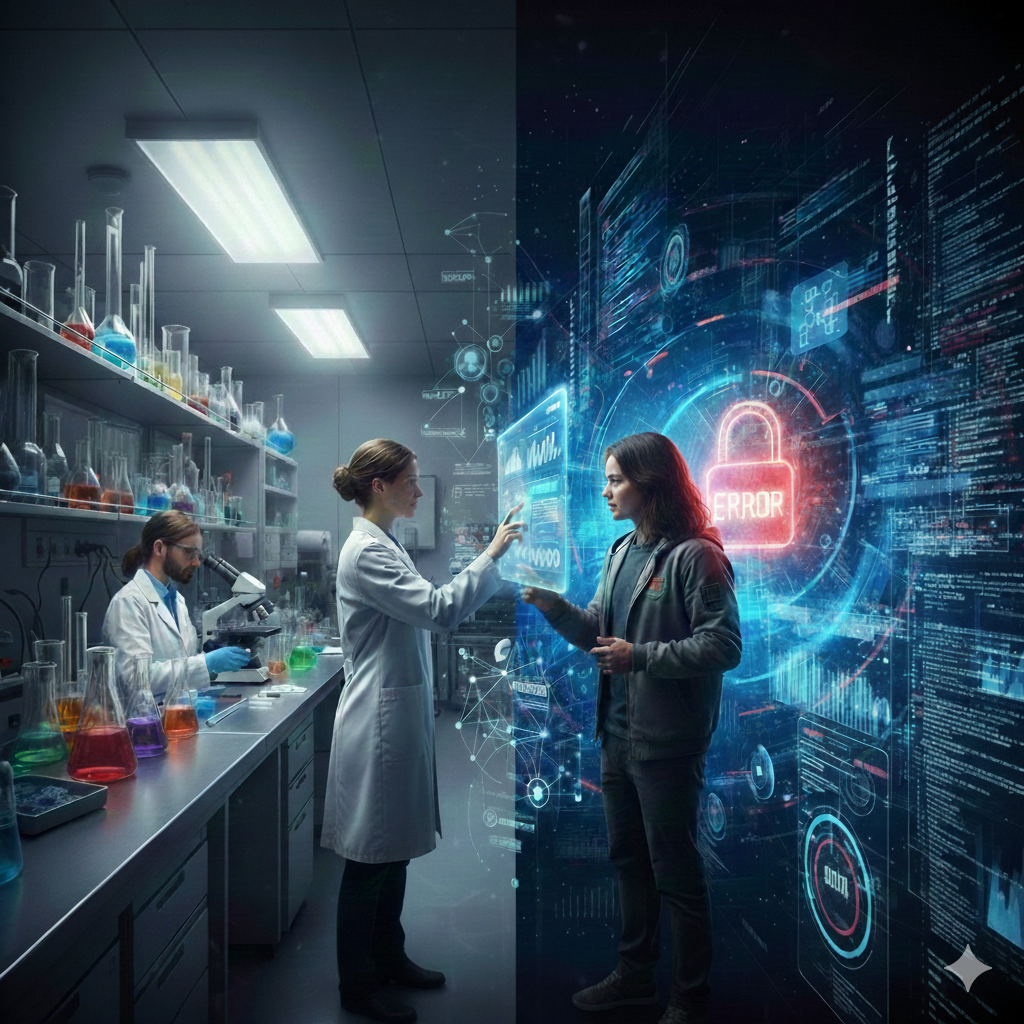
The goal should not be:
“Every biologist must learn Python.”
Instead:
“Computational tools should meet researchers where they are.”
That means:
- pipelines with clearer interfaces
- automation for common pain points
- validation steps that catch errors early
- dashboards that simplify QC
- documentation that assumes a biology background, not a CS degree
Researchers shouldn’t spend hours fighting file formats or dependency errors just to analyze their own experiments.
When biologists and computational developers collaborate especially hybrid scientists who understand both sides research moves faster, cleaner, and with fewer preventable mistakes.
Conclusion
Supporting researchers isn’t always about building advanced algorithms.
Often, the biggest impact comes from handling the “small” tasks that block entire workflows:
- file conversions
- unclear formats
- messy metadata
- directory structures
- encoding issues
When someone from a wet-lab background steps into computational support, they bring a unique advantage:
they know where the real pain points are.
And when those bottlenecks disappear, science accelerates not because of new techniques, but because the workflow finally breathes.